Endeavour's First Flight: The Satellite Caught by Hand
On May 7, 1992, the space shuttle Endeavour launched on its maiden voyage — and its crew pulled off the only three-person spacewalk in history to rescue a stranded satellite.
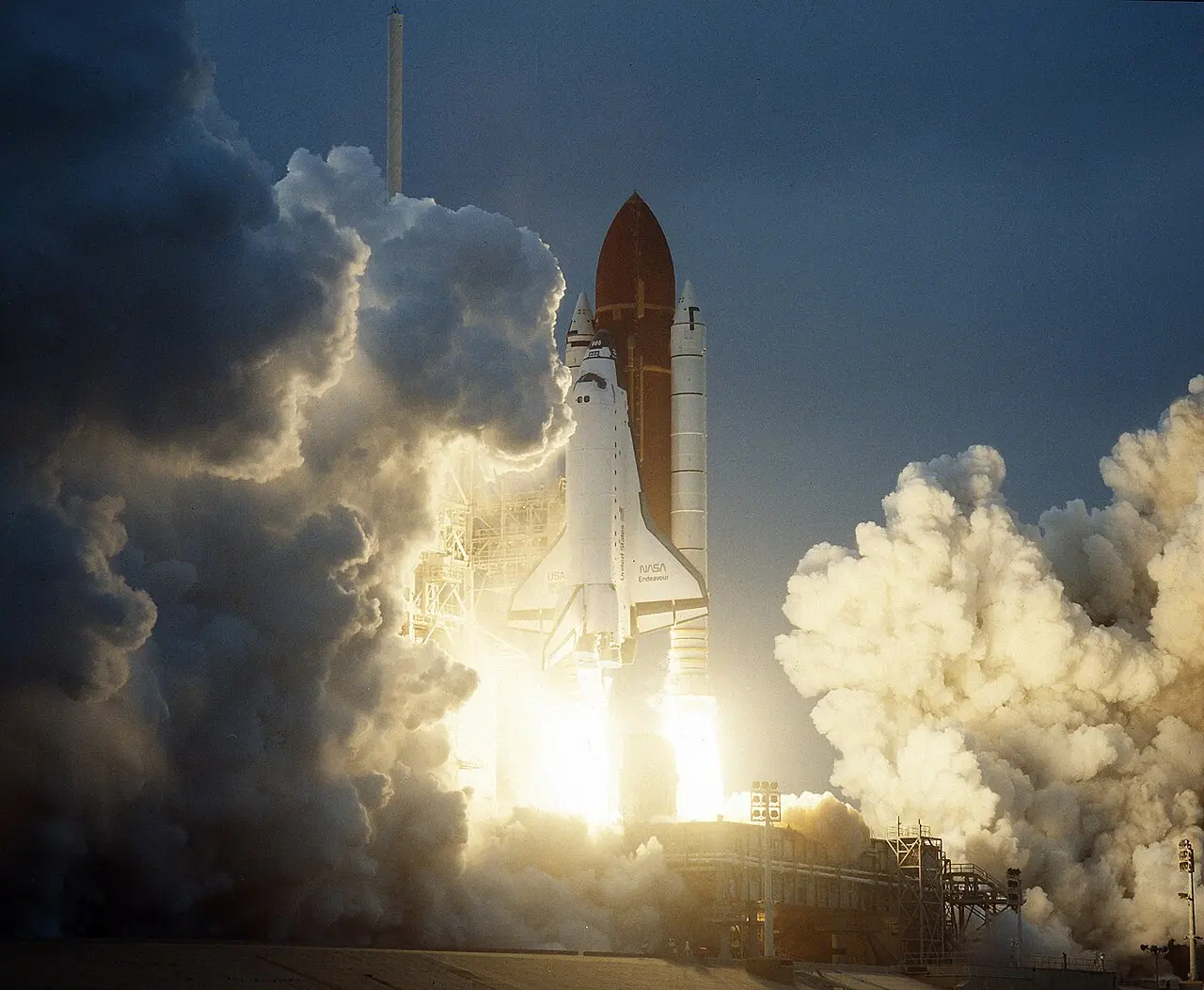
At 7:40 p.m. Eastern time on May 7, 1992, a brand-new space shuttle rose from Launch Pad 39B at Kennedy Space Center in Florida. Endeavour, the newest orbiter in NASA's fleet, was embarking on its very first flight — and the only maiden voyage any shuttle ever made from that pad. Her seven astronauts had a job no crew had attempted before: catch a broken satellite and fix it, by hand, in orbit.
The patient was Intelsat 603, a 4.5-ton communications satellite stranded in the wrong orbit since March 1990, when the rocket meant to boost it to its working altitude failed. Two years of drifting had made it a very expensive piece of space junk. The plan: rendezvous with it, grab it, bolt on a new rocket motor, and send it on its way to the geosynchronous orbit it was built for.
Commander Daniel Brandenstein flew Endeavour to within reach of the tumbling satellite, and mission specialists Pierre Thuot and Richard Hieb went outside to snare it with a specially built capture bar. It didn't work. They tried again the next day. It didn't work again.
So NASA improvised something extraordinary. On the third attempt, three astronauts went out together — Thuot, Hieb, and Thomas Akers — while Brandenstein delicately maneuvered the 100-ton orbiter to within a few feet of the drifting satellite. The three spacewalkers simply grabbed the 4.5-ton behemoth with their gloved hands and held it steady while the capture bar was attached. It remains the only three-person spacewalk in the history of spaceflight, and at 8 hours and 29 minutes, the longest spacewalk ever made at the time.
With the satellite secured, the crew fitted its new motor, released it, and watched the engine fire it toward its proper orbit, where it went on to serve for years. The mission, STS-49, also set another record: four spacewalks on a single flight, a first for the American program.
Endeavour touched down at Edwards Air Force Base on May 16, after traveling 3.7 million miles. She would go on to fly 25 missions, including the first Hubble Space Telescope repair — a mission that saved one of science's greatest instruments. But her legend was made on her first trip — the night seven astronauts proved that when the tools don't work, sometimes you just reach out and grab the problem yourself.
Photo: NASA, public domain (via Wikimedia Commons).