
VE Day: The War in Europe Ends
On May 8, 1945, Germany's unconditional surrender took effect, and millions across the Allied world poured into the streets to celebrate the end of World War II in Europe.
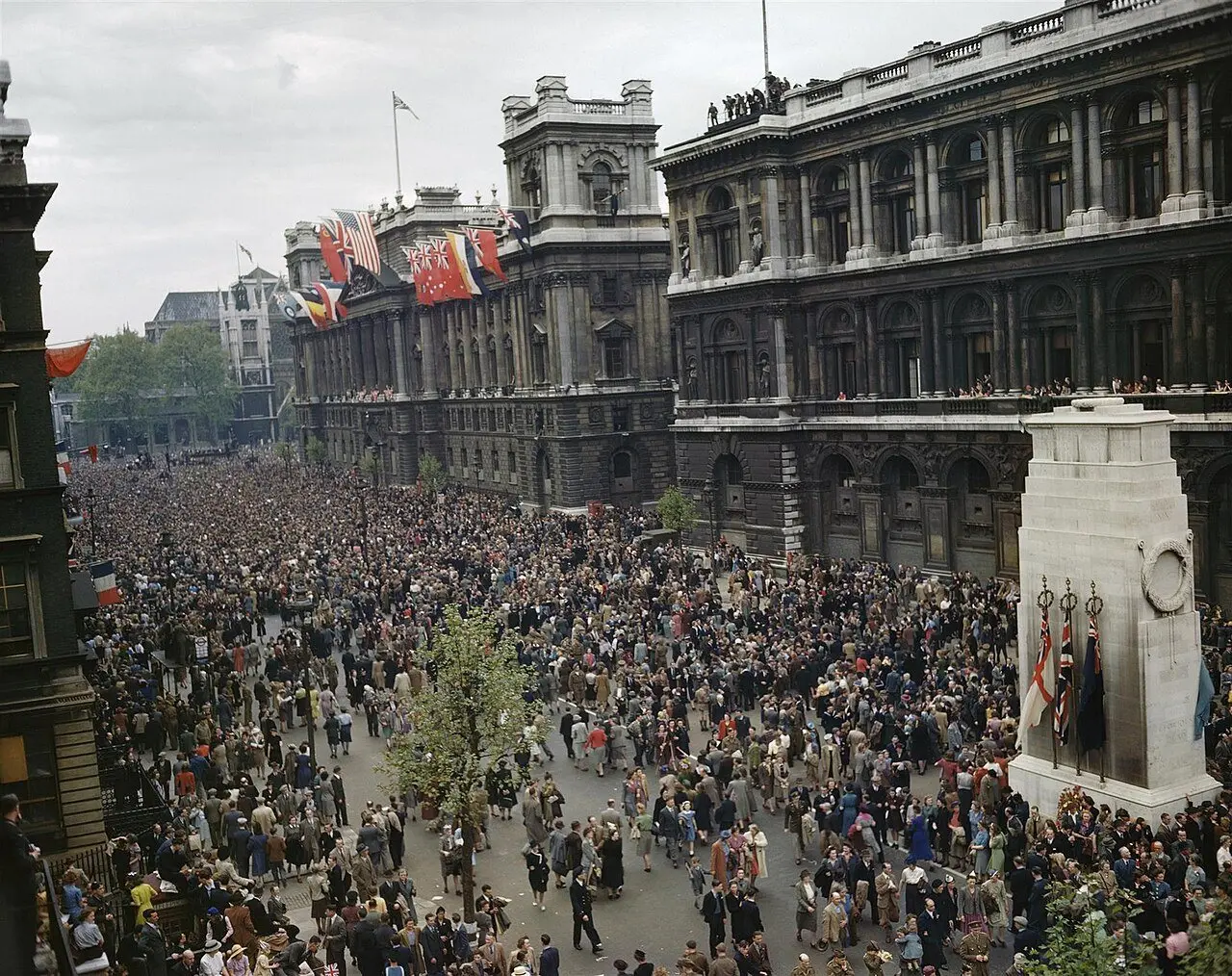
On the night of May 8, 1945, London sang. After nearly six years of blackout curtains, rationing, and the Blitz, more than a million people poured into the streets of the British capital. In Trafalgar Square and along the Mall to Buckingham Palace, they cheered as King George VI and Queen Elizabeth, accompanied by their daughters and Prime Minister Winston Churchill, stepped onto the palace balcony. Churchill raised his voice over the roar: "God bless you all. This is your victory."
The path to that night had begun a week earlier. Adolf Hitler had killed himself in his Berlin bunker on April 30, and command of Nazi Germany passed to Grand Admiral Karl Dönitz. At 2:41 a.m. on May 7, the German delegation signed an act of military surrender at Allied headquarters in Reims, France. But the Soviet Union demanded that the definitive signing take place in Berlin, the seat of the Nazi government.
So on the evening of May 8, in the Berlin suburb of Karlshorst, Field Marshal Wilhelm Keitel signed the German Instrument of Surrender — unconditional surrender to the Allies — before Marshal Georgy Zhukov of the Soviet Union, Air Chief Marshal Sir Arthur Tedder for the Allied Expeditionary Force, General Carl Spaatz for the United States, and General Jean de Lattre de Tassigny for France as witnesses. The ceasefire took effect at 11:01 p.m. Central European time. World War II in Europe was over.
The surrender document was blunt. Article 2 ordered the German High Command to "issue orders to all German military, naval and air authorities and to all forces under German control to cease active operations at 23.01 hours Central European time on 8 May 1945." Some pockets kept fighting — the Courland Pocket in Latvia did not surrender until May 10, and the Prague offensive in Czechoslovakia ended on May 11 — but the war's outcome was no longer in doubt anywhere.
Celebrations erupted throughout the Western world, especially in the United Kingdom, North America, and the Soviet Union. (Russia marks the victory on May 9, since it was already past midnight in Moscow when the signing took place.) There was dancing in the streets of London, Toronto, and Paris — joy mixed with exhaustion after a war that had killed tens of millions.
The fighting was not over everywhere: the war in the Pacific continued until Japan's surrender that September, and some battles in Europe sputtered on for days. But May 8 became the day the Allied victory over Nazi Germany became real. It is remembered as a celebration and as a tribute — to the soldiers who fought, to the civilians who endured, and to the hope that a continent that had torn itself apart could finally begin to heal.
Photo: British official photographer, public domain (via Wikimedia Commons).