The Morning a Giant Fell: General Motors Goes Bankrupt
On June 1, 2009, General Motors filed for Chapter 11 bankruptcy in New York, the largest manufacturing collapse in American history.
On the morning of June 1, 2009, the largest industrial company in American history admitted it could not pay its bills. At about 8:00 a.m. Eastern time, General Motors filed for Chapter 11 bankruptcy protection in federal court in Manhattan — listing $82.29 billion in assets against $172.81 billion in debts, the biggest manufacturing bankruptcy the United States had ever seen.
The date was no accident. June 1 was the deadline the U.S. Treasury had set for GM to produce an acceptable plan to make itself viable — and the 101-year-old company, founded in 1908 and once the mightiest automaker on earth, could not do it. The global financial crisis had frozen car sales and credit markets, and GM's cash was nearly gone. Deeper problems had been building for decades: the company carried enormous health-care and pension obligations for hundreds of thousands of retirees, adding an estimated $1,500 or more to the cost of every vehicle, while its eight-brand lineup — Chevrolet, Pontiac, Buick, Saturn, Hummer, Saab, Cadillac, GMC — competed with itself as foreign rivals built the smaller, more fuel-efficient cars buyers wanted.
The bankruptcy was engineered as a rescue, not a liquidation. With $33 billion in emergency financing, the government backed the sale of GM's healthy operations to a new company, NGMCO Inc. — "New GM" — while the old corporation's debts and unwanted assets were left behind in what the press called "Bad GM." (The old shell was renamed the Motors Liquidation Company.) Factories kept running, workers kept getting paid, and warranties were honored through the proceedings. GM's old stock was delisted to over-the-counter trading, and on June 8 the company was removed from the Dow Jones Industrial Average, replaced by Cisco Systems — a symbolic passing of the torch from the industrial age to the digital one.
Forty days later, the restructuring was done. Pontiac, Saturn, and Hummer were shut down entirely, Saab was sold to the Dutch maker Spyker, and the company concentrated on four brands: Chevrolet, Cadillac, Buick, and GMC. The federal government committed about $30 billion in new financing on top of the more than $19 billion it had already lent — a bailout that sparked fierce national debate about whether any company should be "too big to fail."
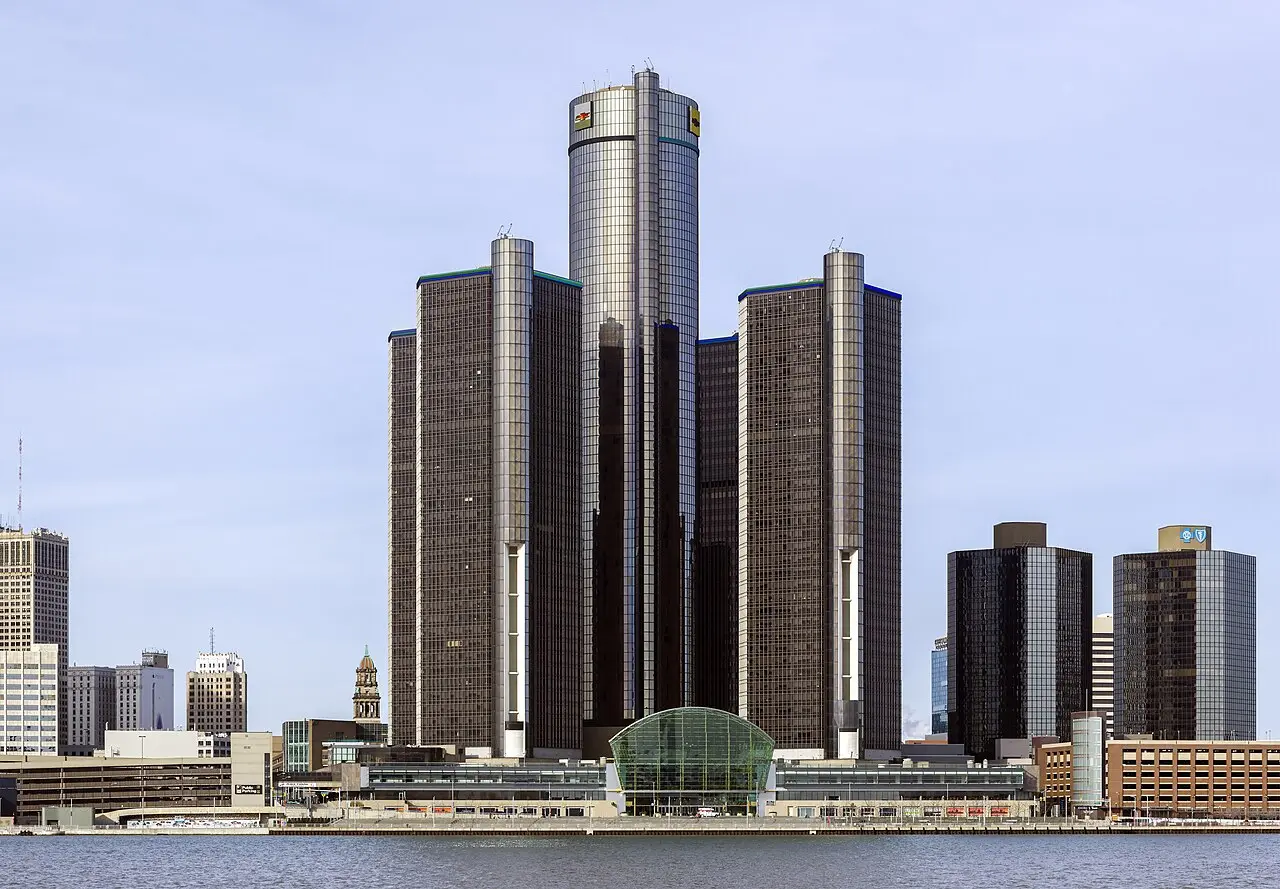
It mattered because it was a hinge moment for American industry. The bankruptcy proved that even the giants of the 20th century could fall, and that survival sometimes requires the humbling admission that the old way of doing business is finished. General Motors emerged leaner, repaid its rescue loans, and remains headquartered in Detroit's Renaissance Center — the glass-and-steel towers on the riverfront that still anchor the city's skyline.
Photo: Crisco 1492, public domain (via Wikimedia Commons). The Renaissance Center in Detroit, Michigan, General Motors' world headquarters on the Detroit riverfront.