Operation Frequent Wind: Saigon's Great Escape
On April 29–30, 1975, Operation Frequent Wind airlifted more than 7,000 people out of Saigon in the largest helicopter evacuation in history.
The signal came over the radio as a Christmas song in the middle of April: Bing Crosby singing "White Christmas," right after a forecast calling for 105 degrees in Saigon. Every American in the city who knew the code understood. Get out. Now.
North Vietnam's final offensive had begun in March 1975, and South Vietnamese defenses collapsed with shocking speed — Quang Tri, Hue, Da Nang, Nha Trang, all falling in quick succession. More than 50,000 people had already been flown out of Tan Son Nhut air base on fixed-wing aircraft. Then, on April 28, enemy fire struck the airport, ending the fixed-wing evacuations for good. U.S. Ambassador Graham Martin ordered Operation Frequent Wind: the helicopter evacuation of the last Americans and the South Vietnamese allies most at risk.
Over about 19 hours on April 29 and 30, 81 helicopters shuttled back and forth, landing roughly every ten minutes at the U.S. Embassy, the Defense Attaché compound, and other pickup points, then ferrying their passengers to Navy carriers waiting in the South China Sea. The Defense Department's figures: 1,373 Americans and 5,595 Vietnamese and third-country nationals — more than 7,000 people in all — the largest helicopter evacuation ever attempted.
The operation's most famous image needs a footnote. Hubert van Es's photograph of a helicopter on a Saigon rooftop, long described as the embassy evacuation, was actually taken at a downtown apartment building housing CIA employees — the Pittman Apartments at 22 Gia Long Street — as UPI's photographer, the only one who stayed, captured it on film.
The cost was real. On April 29, Marine Corporal Charles McMahon Jr. and Lance Corporal Darwin Judge were killed in a rocket attack at Tan Son Nhut — the last two American service members killed in the war. Marine Captain Craig Nystul and First Lieutenant Michael Shea died the same day when their helicopter crashed into the sea. At 7:53 on the morning of April 30, the last helicopter lifted off the embassy roof — while hundreds of would-be evacuees were still waiting below.
Hours later, North Vietnamese tanks crashed through the gates of the Presidential Palace, and General Duong Van Minh surrendered to Colonel Bui Tin. Saigon would be renamed Ho Chi Minh City. The Vietnam War was over.
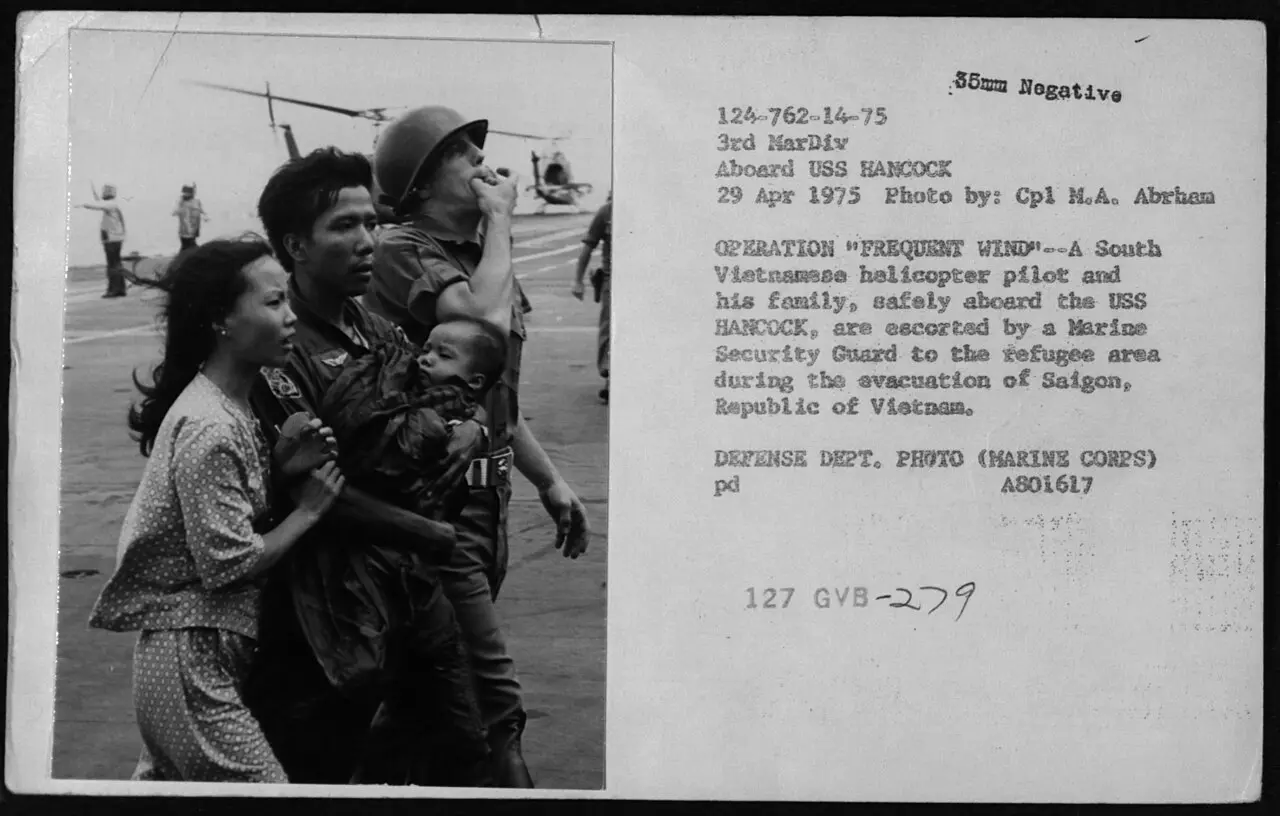
Operation Frequent Wind matters as a chaotic but promise-keeping finale: in the midst of defeat, thousands of South Vietnamese who had worked with the Americans — and who faced the gravest danger — were carried to safety. Many of the refugees in this photograph, a South Vietnamese pilot's family arriving on the USS Hancock, became part of the Vietnamese-American story that followed.
Photo: U.S. Marine Corps (U.S. National Archives, via Wikimedia Commons), public domain.