One Vote Saved a President: The Johnson Impeachment Acquittal
On May 16, 1868, the U.S. Senate acquitted President Andrew Johnson on impeachment charges by a single vote, 35 to 19, one short of the two-thirds needed to convict.
In the spring of 1868, the future of the American presidency hung on a single vote in the United States Senate — and on May 16 of that year, that vote went the president's way.
Andrew Johnson had inherited the White House from the assassinated Abraham Lincoln, and he promptly fell into a furious quarrel with Congress over how to rebuild the defeated South. Congress, led by the Radical Republicans, wanted tough terms and strong protections for newly freed Black Americans; Johnson wanted the old order back, quickly. In 1867 Congress passed the Tenure of Office Act over his veto, forbidding the president from firing Senate-confirmed officials without Senate approval. The law was aimed at one man in particular: Secretary of War Edwin Stanton, an ally of the Radicals.
Johnson decided to test the law. On February 21, 1868, he ordered Stanton removed. The House erupted. On February 24 it voted 126 to 47 to impeach the president — the first presidential impeachment in American history. Eleven articles of impeachment followed, most of them charging Johnson with violating the Tenure of Office Act.
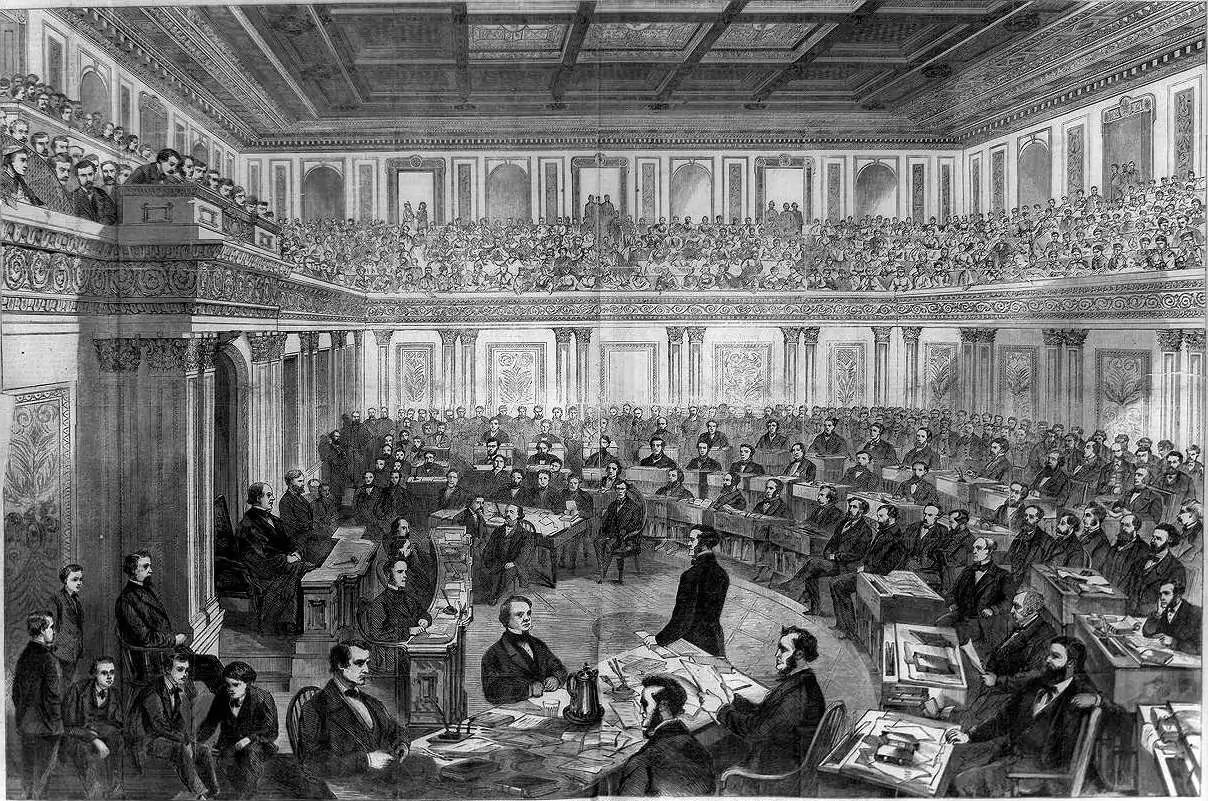
The Senate trial, presided over by Chief Justice Salmon P. Chase, consumed the spring of 1868 and turned Washington into a spectacle. Tickets to the packed Senate galleries were color-coded and printed fresh each day; spectators crowded the lobbies by the thousands. The nation held its breath, because removing a president was — and is — one of the gravest acts a republic can take.
On May 16 the Senate voted first on the broadest of the charges, Article 11. Conviction required two-thirds: 36 of the 54 senators. As the roll was called in alphabetical order, the tension was unbearable. The last undecided senator was Edmund Ross of Kansas, a Republican. When his name came, he voted not guilty. The final tally was 35 for conviction, 19 for acquittal — one vote short. Seven moderate Republicans had crossed party lines to join the twelve Democrats voting to spare the president.
The House managers had gambled on Article 11 as their strongest case. Ten days later, on May 26, the Senate took the same 35–19 vote on Articles 2 and 3, then adjourned the trial. Johnson was acquitted. Thaddeus Stevens, the Radical leader who had driven the impeachment, had famously warned that the country was "going to the Devil." It didn't. Johnson simply finished his term and left office on March 4, 1869 — and in a twist nobody expected, he won election back to the Senate from Tennessee in 1875, returning to the very chamber that had tried him. He died three months later.
History has largely sided with the acquitters. In 1926 the Supreme Court declared the Tenure of Office Act unconstitutional, which was the heart of the case against Johnson all along. The trial's real legacy is the precedent it set: that impeachment is reserved for genuine crimes against the republic, not for unpopularity or political disagreement. A president kept his office that May by the narrowest margin the Constitution allows — and the Republic, barely tested, held.
Photo: Theodore R. Davis, public domain (via Wikimedia Commons).