
Mutiny on the Bounty: Cast Adrift on the Open Sea
On April 28, 1789, Fletcher Christian seized HMS Bounty and set Captain Bligh adrift in an open boat on the Pacific.
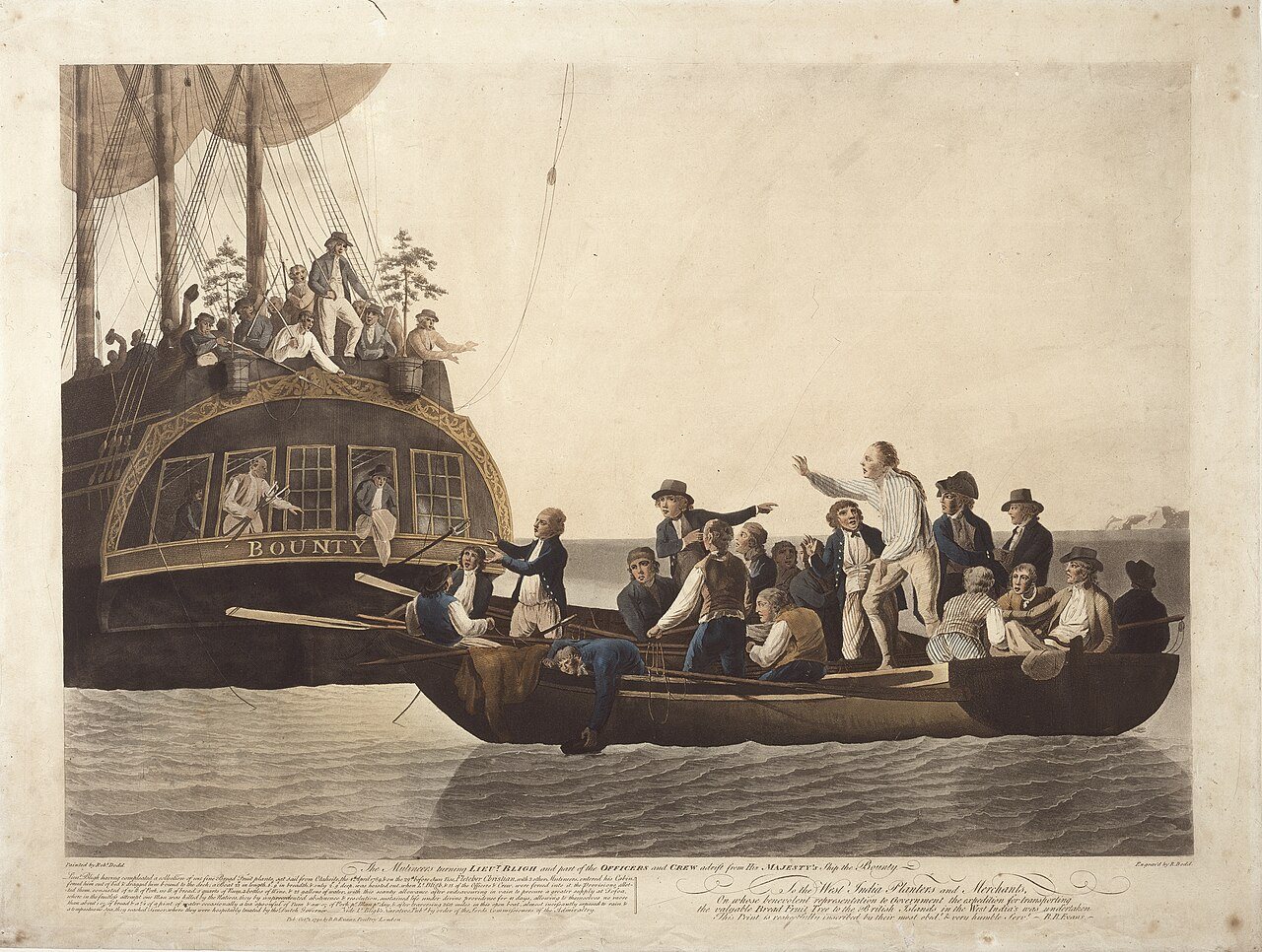
Just before sunrise on April 28, 1789, Fletcher Christian and two armed men slipped into Captain William Bligh's cabin, tied the sleeping captain's hands behind his back, and dragged him on deck in his nightshirt. By mid-morning, the most famous mutiny in naval history was complete.
HMS Bounty was on a botanical mission. Bligh had sailed her to Tahiti to collect hundreds of breadfruit plants, a cheap food the British hoped to grow in the West Indies. The ship reached Tahiti in October 1788 and stayed five happy months while the cuttings took root. When the Bounty finally sailed for home on April 4, 1789, the crew was already grumbling — and Bligh had quarreled bitterly with his master's mate and former friend, Fletcher Christian.
Christian had even planned a desperate escape from the ship on a raft. Instead, a determined group of sailors persuaded him to take the ship itself. In the early hours of April 28, about 30 nautical miles from Tonga, they seized control without firing a shot. Bligh and 18 men who stayed loyal to him were forced into the ship's open launch — barely 23 feet long — with a quadrant and a pocket watch for navigation, a few days' food and water, but no charts and no compass. Then the Bounty sailed away, and the little boat was left alone on the vast Pacific.
What happened next is one of the great feats of seamanship in history. A stop at the island of Tofua for supplies turned violent when a crewman was killed by hostile islanders. Bligh then made a breathtaking decision: rather than risk another landing, he would sail the open boat all the way to Timor in the Dutch East Indies, some 3,600 miles away. For 47 days the overloaded launch crossed open ocean, the men rationed to almost nothing, navigating by sun and stars. Bligh recorded the distance as 3,618 nautical miles. On June 14, 1789, the gaunt survivors reached Timor. Bligh continued to Batavia — modern-day Jakarta — found passage home, and reported the mutiny to the Admiralty in London on March 15, 1790.
The mutineers fared worse in the long run. Christian and eight others, with Tahitian companions, sailed the Bounty to remote Pitcairn Island and burned the ship to hide their tracks. Their little colony went undiscovered until 1808, though their descendants still live on Pitcairn today. The Royal Navy sent HMS Pandora to hunt down the rest: she captured 14 men at Tahiti in March 1791, then wrecked on the Great Barrier Reef that August with the loss of 31 of her crew and four prisoners. The surviving mutineers were court-martialed in England — three were hanged, four acquitted, and three pardoned.
Hollywood has told this story many times, usually as a simple tale of a tyrant and a hero. The truth is messier: Bligh was a brilliant navigator and no crueler than most captains of his day, and Christian's rebellion was born of personal quarrel as much as principle. But whatever the rights and wrongs, the mutiny of April 28, 1789, endures because of what followed — a 47-day voyage across an empty ocean in an open boat that proved what extraordinary seamanship, and extraordinary stubbornness, can achieve.
Image: Robert Dodd, public domain (via Wikimedia Commons).