Fun's Word-Cross: The Puzzle That Conquered the World
On December 21, 1913, the New York World printed Arthur Wynne's 'word-cross' — the first modern crossword puzzle.
The world's most popular puzzle was born because a newspaper editor needed something new for the Christmas edition.
On December 21, 1913, readers of the Sunday New York World opened the paper's 'Fun' supplement and found something they had never seen: a diamond-shaped grid laced with words running across and down, with 31 clues to fill it in. Its creator called it a 'Word-Cross Puzzle.' The top row was already filled in, spelling F-U-N. It was an instant hit — readers loved it so much they began composing their own and mailing them in, and within weeks the puzzle became a regular feature.
The inventor was Arthur Wynne, a Liverpool-born journalist who had emigrated to America at nineteen, worked for the Pittsburgh Press, played violin in the Pittsburgh Symphony Orchestra, and eventually landed at the New York World editing its puzzle page. He was riffing on older word squares — children had played with those for generations — but his innovations were the ones that stuck: horizontal and vertical lines dividing the grid into boxes for solvers to fill, and later the symmetrical black squares that separate words in the modern puzzle. Even the name came about by accident: a few weeks after the debut, a typesetting error flipped 'Word-Cross' to 'Cross-Word,' and the name stuck.
For a decade, the World had the craze to itself. Then, in 1924, a young publishing house issued a book collecting the World's puzzles — The Cross Word Puzzle Book, sold with a pencil tucked inside — and the crossword exploded across America. It was the very first title from the new firm of Simon & Schuster, and it became a runaway bestseller — a hundred thousand copies in its first weeks — that launched the publishing house; by that fall the firm had four more puzzle books on its list. Newspapers everywhere scrambled to add puzzles; the New York Times, the great holdout, finally caved with a Sunday puzzle in 1942 and a daily in 1950. Wynne, who became a naturalized American citizen and died in Florida in 1945, lived to see his Christmas filler become a daily ritual for millions.
More than a century later, the crossword remains what Wynne made it: a small, perfect machine for the pleasure of knowing things — thirty-one clues that turned into billions of solved grids.
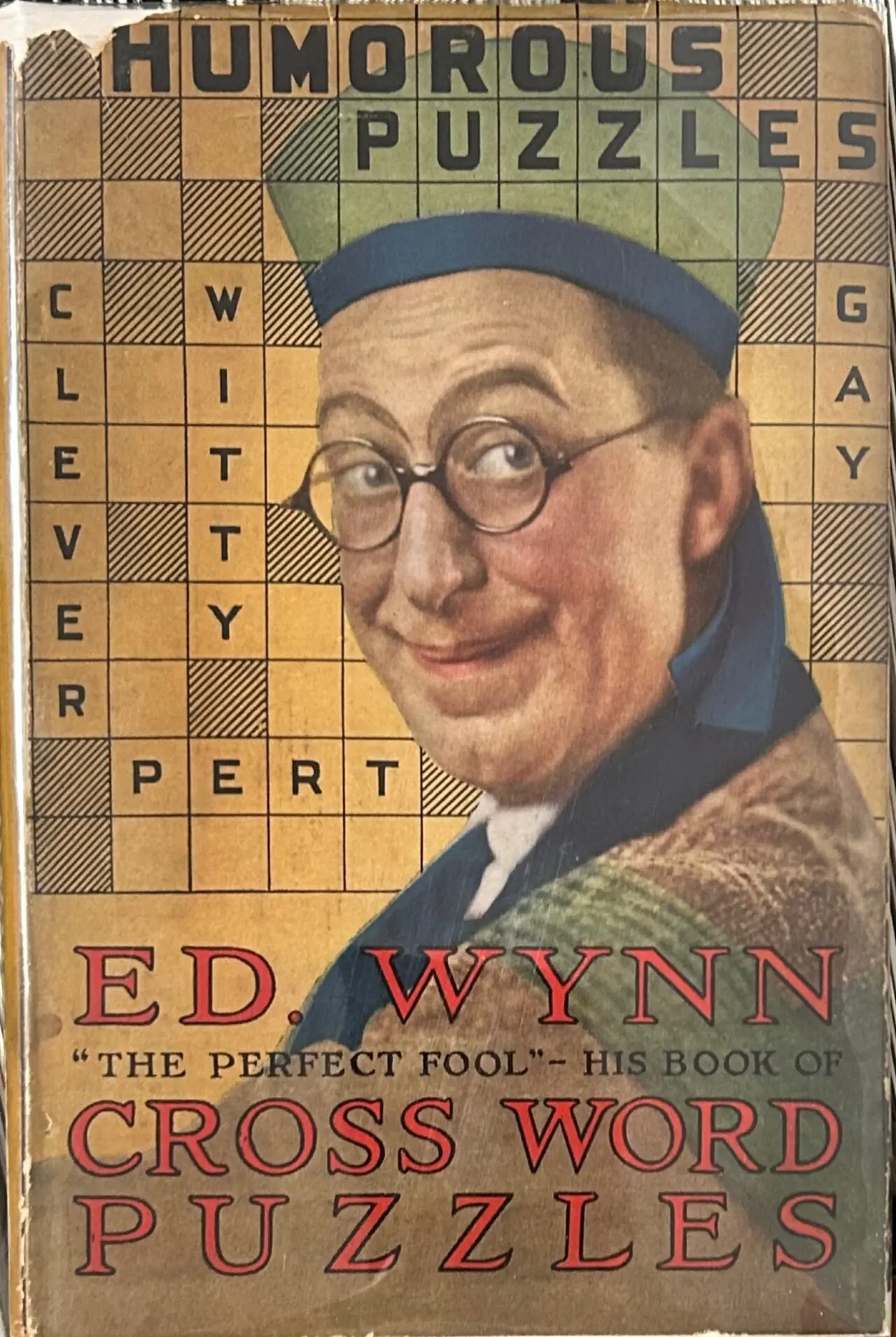
Photo: cover of Ed Wynn's 1924 cross-word puzzle book, public domain (via Wikimedia Commons).