Forty-Four Settlers and a River: The Day Los Angeles Was Founded
On September 4, 1781, forty-four settlers from northern Mexico founded a tiny farming town on the banks of a river — and named it El Pueblo de Nuestra Señora la Reina de los Ángeles.
Los Angeles began with forty-four exhausted travelers, a herd of livestock, and a plan drawn up by a man most of them had never met.
They were called los pobladores — the settlers. Recruited in early 1781 from the provinces of Sonora and Sinaloa in what is now northern Mexico, they walked roughly a thousand miles to a spot along a small river, near a Tongva village called Yaanga. They arrived in eleven families — men, women, and children — carrying official orders: Spanish Governor Felipe de Neve was planting a civilian town on the far edge of the Spanish Empire, by command of King Carlos III.
The plan was practical, not romantic. The missions of Alta California needed food, and the military presidios needed people. De Neve laid the town out according to Spain's Laws of the Indies: a central plaza with streets set at forty-five-degree angles, house lots, and planting fields. Each family received ten pesos a month, some farm animals, and a small house. Their job was to farm — to grow the crops that would feed the missions and the soldiers up and down the coast.
The town's full name was El Pueblo de Nuestra Señora la Reina de los Ángeles de Porciúncula — "The Town of Our Lady the Queen of the Angels of the Porciúncula River." Mercifully, the mouthful soon shrank to simply Los Angeles.
The settlers themselves were a portrait of colonial Mexico: Spaniards, mestizos, mulattoes, and Indigenous people — and scholars have documented that at least ten, and perhaps as many as twenty-six, of the forty-four were of African descent. They had survived a brutal journey that began with some sixty people before smallpox thinned their ranks. They dug irrigation channels called zanjas, raised simple adobe homes, and started over.
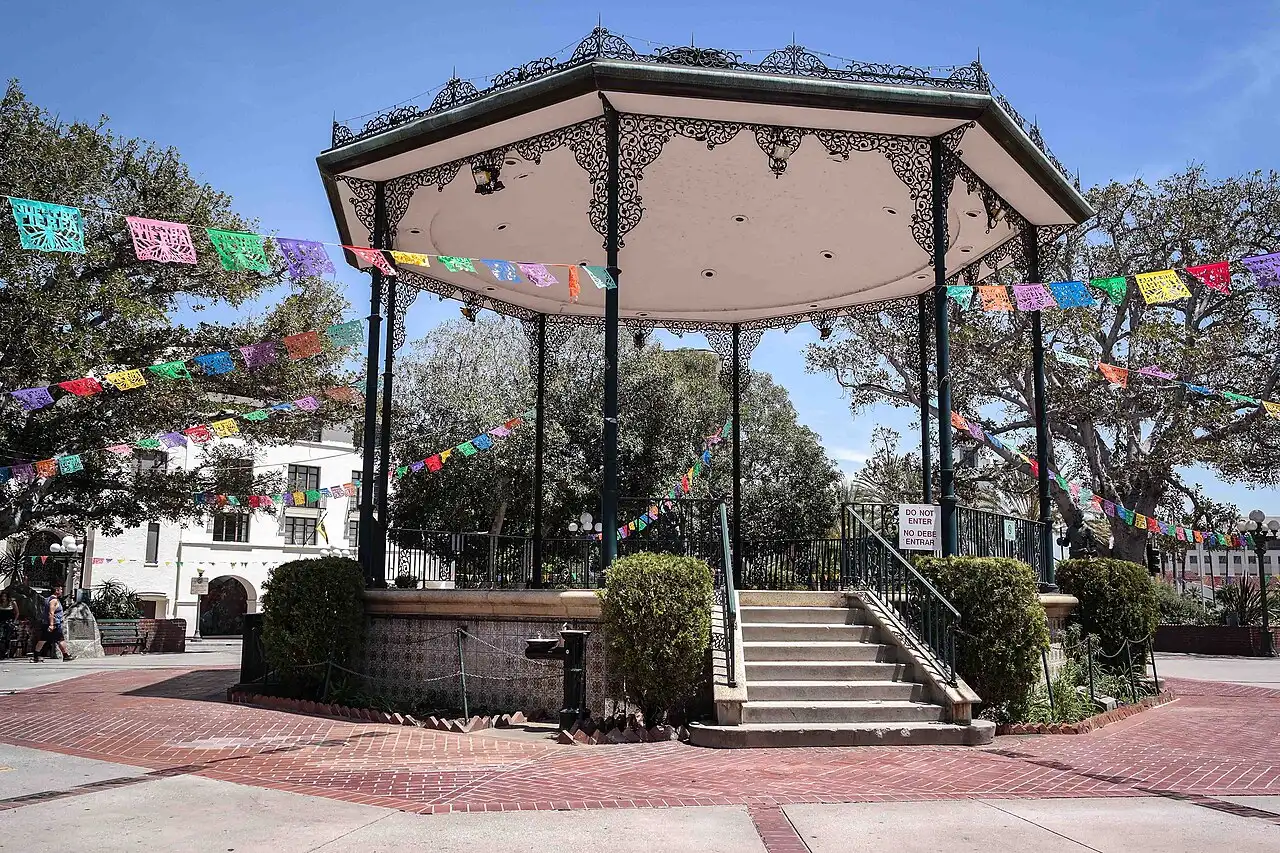
Life was hard, and growth was achingly slow. The first settlement stood near the river; in 1815 a flood washed it away, and the pueblo was rebuilt uphill on the site of today's plaza — the same Plaza de Los Angeles that still anchors the city's historic district. From forty-four people in 1781, the town grew to barely sixteen hundred by 1850. Then came American statehood, the railroad, and a boom that carried the population past a hundred thousand by 1900 — on its way to nearly four million.
Why it matters: few great cities are as young as Los Angeles, and few rose from such a humble blueprint. Hollywood, aerospace, the Dodgers, the food trucks — all of it traces back to a cluster of adobe huts beside a modest river, planted because a Spanish governor needed a food supply. Every September 4, descendants of the original forty-four re-enact the settlers' march from Mission San Gabriel — a reminder that one of the largest cities in America was, not long ago, somebody's farm.
Photo: Visitor7, CC BY-SA 3.0, via Wikimedia Commons.