
The Broadcast That Beat Polio
On March 26, 1953, Jonas Salk announced on national radio that his polio vaccine had worked in human trials — a moment that changed medicine.
In the summer of 1952, American parents lived in fear of something they could not see and could not fight. Poliomyelitis — polio — struck hardest in the warm months, and that year it struck harder than ever: 58,000 new cases across the United States, more than 3,000 dead. Children were kept from swimming pools and movie theaters. The iron lung, a metal cylinder that breathed for paralyzed patients, became the grim symbol of a disease that had terrorized families for generations.
On the evening of March 26, 1953, a quiet young scientist went on the CBS radio network and told the nation the fear might be over.
Dr. Jonas Salk was a virologist at the University of Pittsburgh who had spent years developing a vaccine from killed poliovirus strains. The idea — tried and failed in the 1930s — was that a dead virus could teach the immune system to recognize the living one. Funded by the March of Dimes, Salk tested the vaccine first on former polio patients and on children at two Pittsburgh-area institutions. Then, in an act of conviction he later shrugged off, he injected himself, his wife, and his three sons — boiling the needles and syringes on his own stovetop first.
That March evening, on a national broadcast, Salk announced the early results: the vaccine was producing immunity in humans. Two days later he published the findings in the Journal of the American Medical Association. He became a celebrity overnight.
But "safe" was not yet proven — only promising. The great proof came in 1954, in the largest public-health experiment in American history. Nearly 1.8 million children became "polio pioneers," receiving either vaccine or placebo in a double-blind trial. On April 12, 1955, the verdict was declared: the vaccine was "safe, effective and potent."
That same day, CBS newsman Edward R. Murrow asked Salk who owned the patent. "Well, the people, I would say," Salk answered. "There is no patent. Could you patent the sun?"
The rollout was not without tragedy. A batch from Cutter Laboratories in Berkeley, California, contained live virus; some 200 children were left paralyzed and ten died. The incident shook confidence — but it also led to far tighter manufacturing standards, and the campaign pressed on. By 1957, American polio cases had dropped below 6,000, down from 58,000 five years earlier. Polio was officially eliminated in the United States in 1979.
Why does a radio announcement from 1953 still matter? Because it was the moment medicine stopped being helpless against one of childhood's cruelest diseases — and because of how it happened. Salk, funded by dimes collected by ordinary citizens, gave the vaccine away. In an age when lifesaving treatments are priced like luxury goods, March 26 remains a reminder of a different model: publicly funded science, tested with personal courage, handed to the world for free.
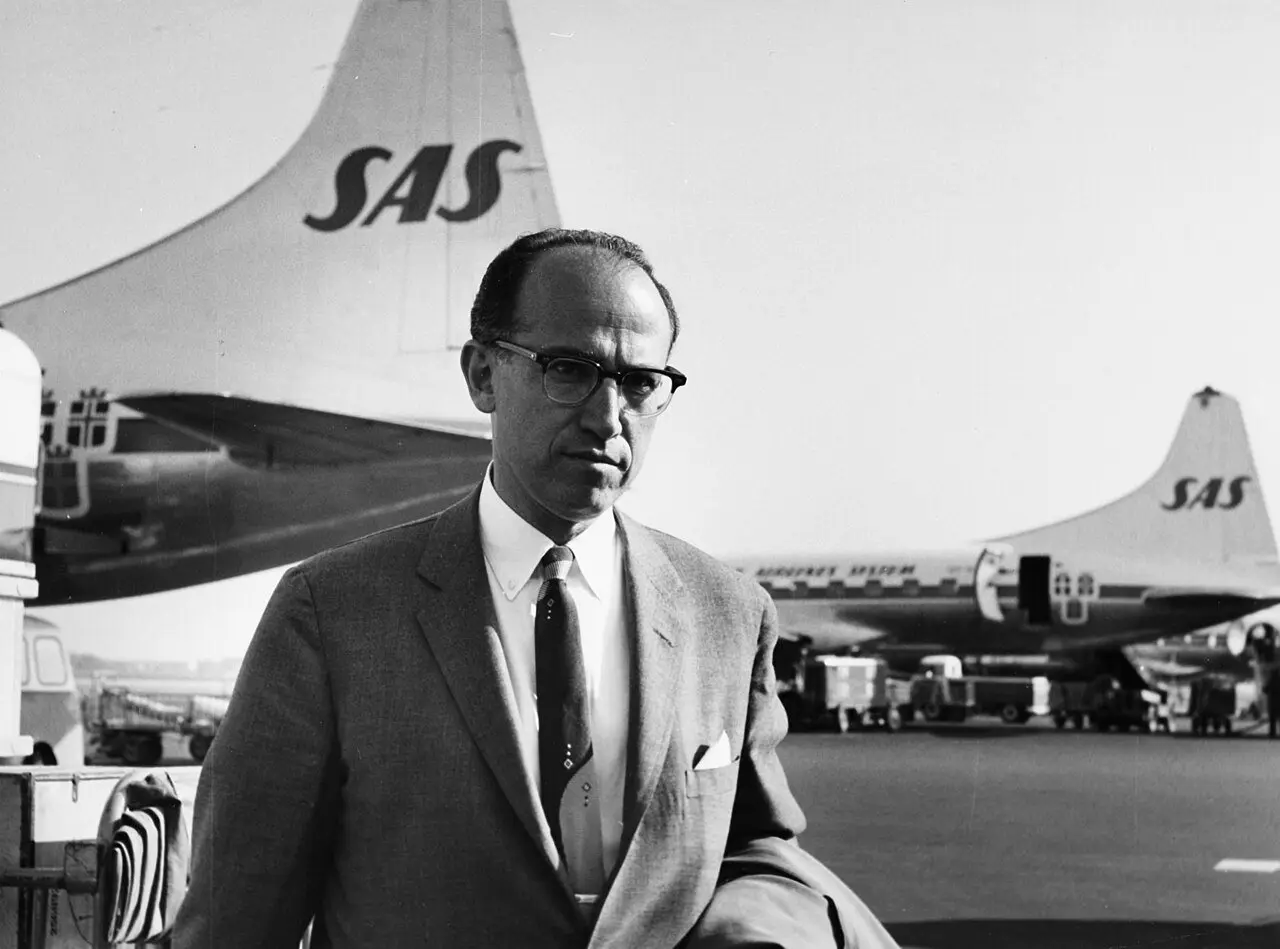
Photo: SAS Scandinavian Airlines, public domain (via Wikimedia Commons).